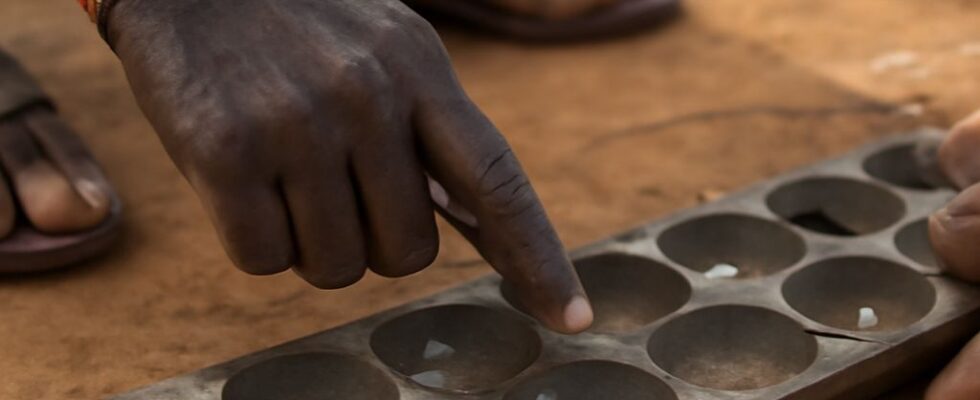
The direct answer to the question “what is Mancala?” is that it is a family of count-and-capture board games, not one universal game with one official board. Most versions use rows of pits filled with seeds or stones. Players sow those counters around the board, and many versions capture counters under specific last-seed conditions.
The name commonly describes games played across Africa, the Middle East, Asia, and parts of the Caribbean. The boxed game sold as “Mancala” today usually follows the Kalah ruleset, which is one modern member of this much broader family.
What Is Mancala? Pits, Seeds, and Sowing
A Mancala board consists of small depressions called pits, arranged in two, three, or four rows. Players place seeds, stones, shells, or other counters in the pits. Larger scoring pits, called stores or mancala, may sit at either end of the board, although many traditional games do not use them.
At the start of a turn, a player chooses one pit on their side and removes all its counters. They then distribute the counters one at a time into neighboring pits. This process is called sowing. The direction may be clockwise or counterclockwise, and some games allow sowing to continue through several rounds when the last counter lands in an occupied pit.
Those shared actions define the family. Board shape, starting position, direction of play, ownership of pits, and the meaning of the final counter can change considerably from one regional game to another.
How Sowing, Capturing, and Stores Work
Sowing is more than moving pieces: it changes the number of counters in each pit and determines where a turn ends. Players therefore plan around both immediate moves and the next available sowing sequence. A pit with many counters can carry a move across much of the board, while a nearly empty pit may control a precise landing point.
Capturing usually depends on the final counter placed during a sowing turn. In some games, landing in an empty pit on the player’s own side allows them to take counters from an opposing pit. Other rules capture a certain number, capture from a matching row, or award counters when a pit reaches a specified total. Some versions use relay sowing, in which the player picks up the contents of the pit where the previous sowing ended and continues.
Stores provide a place to keep captured counters and often count toward the final score. A player may sow into their own store but skip the opponent’s. In games without stores, captured counters may be placed aside, or the winner may be the player who collects the most after one side becomes empty. These differences are why instructions for a named variant matter more than the word “Mancala” alone.
Mancala History Across Africa and Beyond
Mancala history does not begin with one securely established date or a single universally accepted inventor. Archaeological sites in Africa and nearby regions contain rows of cup-shaped holes that some researchers have connected with pit-and-counter games. However, similar marks can have other uses, so such evidence does not prove that every ancient row of holes was a Mancala board.
Written descriptions and clearer ethnographic records appear at different times and in different places. The history of Mancala is therefore best understood as a long development of related local traditions, shaped by trade, migration, language, and community practice. Rules were often transmitted orally, meaning that a game could change while retaining its basic sowing structure.
African forms are especially diverse. Games associated with West Africa include Oware, while East African traditions include Bao and Uganda’s Omweso. Other forms developed across the Red Sea, the Arabian Peninsula, South Asia, Southeast Asia, and the Caribbean. This broad distribution explains why no single origin story or rulebook can represent every game in the family.
Mancala: An African Board Game Family, Variants, and Regional Rules
Mancala is often described as an African board game, but that label should identify an important historical region, not imply one standardized African game. Regional variants differ in board size, pit arrangement, number of counters, sowing direction, and whether players can make relay moves.
- Oware: Commonly played on two rows of six pits, with captures often based on the final seed creating a qualifying count in an opponent’s pit.
- Bao: A strategically complex East African game that commonly uses four rows and distinctive opening and relay-sowing rules.
- Omweso: A four-row Ugandan game known for repeated sowing and tactical control of multiple pits.
- Congkak and Sungka: Southeast Asian forms that commonly use two rows of pits and end stores, with rules emphasizing circulation and collection.
These games are related through their sowing logic, not because they share identical rules. Even neighboring communities may use different capture conditions or starting arrangements. A board’s appearance can suggest a family resemblance without telling you how that particular game is played.
What Mancala Usually Means Today: Kalah Rules
When people in North America or Europe say “Mancala,” they often mean Kalah, a modern ruleset commonly sold under the broader family name. A standard Kalah board has two rows of six pits and one large store at each end. Each player controls the six pits nearest them and begins with four seeds in each pit.
On a turn, a player empties one of their pits and sows one seed into each following pit, including their own store but skipping the opponent’s store. If the last seed lands in the player’s store, they take another turn. If it lands in an empty pit on their own side, they capture that seed and the seeds in the directly opposite pit, placing them in their store.
The game ends when all six pits on one player’s side are empty. The other player moves any remaining seeds into their store, and the larger store total wins. Commercial boards and house rules can vary, but this extra-turn, opposite-pit capture, and end-of-game sweep are the rules most often intended by the modern Kalah version.