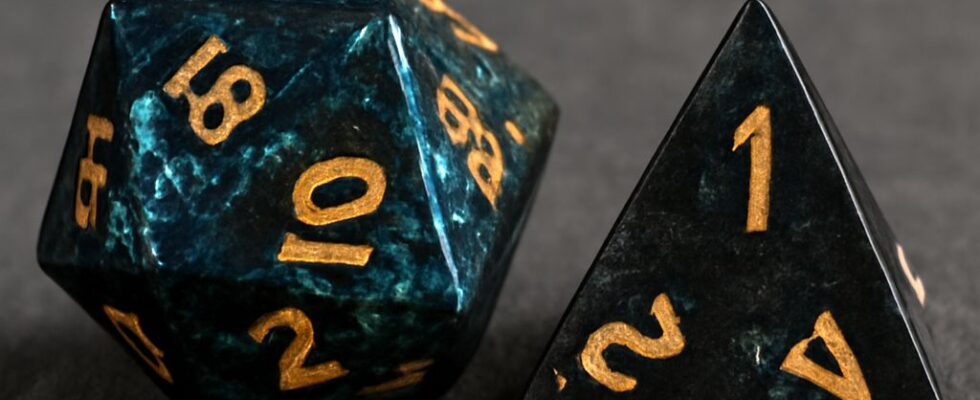
A seven-piece set gives you the dice needed for most D&D rolls, from a sword attack to a spell’s damage. A typical role-playing game dice set contains a d4, d6, d8, d10, percentile d10, d12, and d20. Once you can recognize each one and read the notation, you can spend less time counting faces and more time deciding what your character does.
RPG Dice Sets: What Comes in the Bag?
In a D&D dice set, the letter d means die; the number after it tells you how many sides it has. The 2024 D&D Basic Rules use six main types, plus percentile dice for a d100 roll. Their appearances vary, so count faces or read the markings if two look alike.
- d4: Often a small pyramid; used for some weapon damage and other effects. Read the number positioned according to that die’s design.
- d6: The familiar cube; used for many damage rolls and other game effects.
- d8: Eight faces; used for damage from some weapons and spells.
- d10: Ten faces; used for some damage rolls and paired with another d10 for percentile rolls.
- d12: Twelve faces; used for some weapons’ damage and other effects.
- d20: Twenty faces; central to attack rolls, ability checks, and saving throws.
- Percentile d10: Usually marked 00, 10, 20, and so on through 90; paired with the regular d10 to produce a number from 1 to 100.
DND dices in a standard seven-piece set cover these shapes, but your character’s abilities determine which ones you’ll reach for most. A wizard and a fighter using D&D dice may both use a d20 frequently while rolling different dice for damage.
Read a Roll Without Guessing
In D&D dice notation, the number before the d tells you how many dice to roll. The number after it tells you the number of sides. A final number is a modifier to add or subtract.
With your D&D dice, for 2d6 + 3, roll two six-sided dice, add their results, and then add 3. If the dice show 4 and 2, the total is 9. You can roll one d6 twice if that’s all you have; just keep track of the first result. Your rule or character sheet tells you when to use the expression and what the total means.
For 1d100, designate one d10 for tens and the other for ones before rolling. With a die marked in tens, 70 plus 1 reads 71. A result of 00 and 0 reads 100; 00 and 7 reads 7. Different colors or distinct markings make the pair easier to identify.
Choose Dice You Can Read and Handle
When comparing RPG dice sets, look at the numbers from your normal seated distance. High contrast helps, especially on a busy or translucent surface. Check that similar-looking dice are easy to tell apart, that numerals such as 6 and 9 have clear orientation marks, and that the d4’s reading position makes sense to you.
Consider your play space too. A tray can keep a lively d20 from escaping the table; a compact set may suit a crowded café. If you play online, a digital alternative to a tabletop RPG dice set can do the arithmetic and show the group the result when the platform supports it. Ask your group which method it uses before buying accessories.
When to Add More Dice
DND dices work one roll at a time, but extras speed up rolls involving several dice. If a spell asks for 8d6, eight cubes let you roll at once; one cube rolled eight times produces the same kind of total. A second d20 in your role-playing dice collection is convenient when advantage or disadvantage calls for two d20s.
A set of dice for a role-playing game should match that game’s rules. Some systems use pools of six-sided dice or custom symbols, so check the rulebook before assuming a polyhedral set is enough. For D&D, start with a readable seven-piece set, then add the dice your character rolls often and choose a tray or digital roller that fits your table.