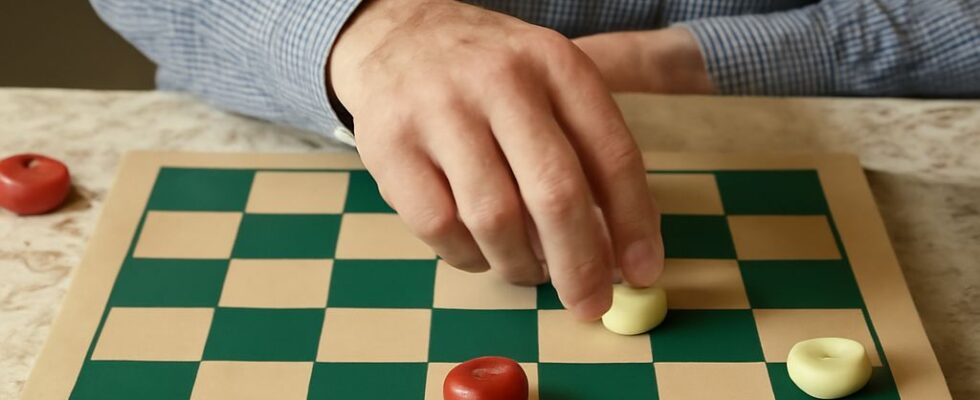
In American checkers, each player starts with 12 pieces, for 24 pieces total. The answer to how many checkers pieces are used is therefore 12 per player on an 8-by-8 board, with pieces placed only on the dark squares.
The answer to who goes first in checkers is Black: Black makes the opening move, then players alternate turns. The rules below use American checkers, also called English draughts, rather than international draughts.
How Many Pieces Are in Checkers? American Checkers Setup and Who Goes First
Piece Count and Starting Squares
Use an 8-by-8 checkerboard with 32 playable dark squares. Each player places 12 regular checkers on the dark squares in the three rows closest to that player. Each starting row contains four pieces, because the pieces occupy every other square.
- Black occupies the three rows on Black’s side.
- Red occupies the three rows on the opposite side.
- The two empty rows in the middle separate the players at the start.
- Only dark squares are used for movement and placement.
Black moves first. A regular checker moves toward the opponent’s side of the board, so the two players travel in opposite diagonal directions. Once a piece reaches the farthest row on the opponent’s side, it can become a king.
Checker Moves: How Regular Pieces Move and Capture
Diagonal Movement and the Mandatory Capture Rule
A regular checker, sometimes called a man, moves one square diagonally forward onto an empty dark square. It cannot move straight ahead, sideways, or backward. A regular checker also captures forward only under American checkers rules.
To capture, jump diagonally over one adjacent opposing piece into the empty square immediately beyond it. Remove the jumped piece from the board. For example, if a red piece is diagonally adjacent to a black checker and the next diagonal square is empty, the black checker must jump over the red piece and land on that empty square.
Captures are mandatory. At the beginning of a turn, check whether the moving player has any legal capture. If one is available, that player must capture rather than make a normal one-square move. If several captures are available, the player may choose any legal capture; American checkers does not require the capture that removes the greatest number of pieces.
A capture is illegal if the landing square is occupied, the jumped piece belongs to the moving player, or the jumped piece is not immediately adjacent. A regular checker cannot capture through another piece or jump over two pieces in one jump.
Multi-Jumps, King Movement, and Becoming a King
The Multi-Jump Sequence
After a capture, inspect the piece’s new square before ending the turn. If that same piece can capture again, it must continue jumping. This is a multi-jump, and the player must complete every available capture in the sequence.
- Jump the opposing piece and land on the empty square beyond it.
- Remove the captured piece.
- Look for another legal capture from the new landing square.
- Continue until no further capture is available.
For example, a checker might jump from c3 to e5 over a piece on d4, then jump from e5 to g7 over a piece on f6. Those are two captures in one turn. If another capture is available after the first landing, the player cannot stop early. When more than one continuation is possible, the player chooses one legal route.
King Movement and Crowning Timing
A regular checker becomes a king when it reaches the opponent’s back row. Crown it immediately, commonly by placing another checker on top of it or turning it over. A king moves one square diagonally in any direction: forward or backward.
A king captures by jumping diagonally over an adjacent opposing piece into the empty square beyond it. Kings can capture forward and backward, and they can make multi-jumps. American checkers uses short-range kings, so a king cannot move several empty squares along a diagonal or jump over a piece from a distance.
If a regular checker reaches the back row during a capture, it is crowned when it lands there. Under American checkers rules, that turn ends at the crowning square; the newly crowned king does not continue the same multi-jump as a king. It may move and capture in either direction on the next turn.
Official Checkers Rules: How to Win or Draw in American Checkers
Blocked Positions, Wins, and Draws
Under these official checkers rules, a player wins when the opponent has no pieces left or has pieces but no legal move. A player with a checker that is completely blocked therefore loses, even if that player still has pieces on the board. A player may also concede the game before either position occurs.
A game is drawn when neither player can force a win. In formal American checkers, a draw may also be claimed when the same position occurs three times with the same player to move, or when each player has made 40 moves without advancing a regular checker or capturing a piece. Players can agree to a draw when continued play cannot produce a meaningful result.