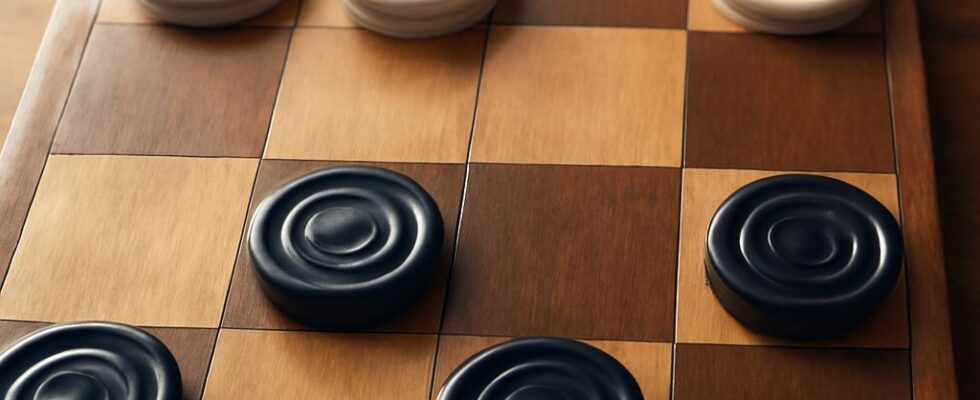
Checkers, also known as draughts, is a classic two-player board game that’s easy to learn yet offers plenty of depth and strategy. The objective is simple: capture all of your opponent’s pieces or block them so they have no legal moves left. If you’re new to checkers, learning the setup, the rules, and some beginner strategies will quickly get you playing with confidence.
Checkers Game Setup and Board Layout
Checkers is played on an 8×8 square board, similar to a chessboard, but only the 32 dark squares are used for play. Each player starts with 12 pieces, usually colored red and black, placed on the three rows closest to them. The board should be oriented so that each player has a dark square in their lower left corner.
To set up a game of checkers:
- Lay out the board so that the bottom-left square is dark for both players.
- Place 12 checkers pieces for each player. All pieces are set on the dark squares of the first three rows closest to each player.
- The central two rows are left empty at the start of the game.
The player with the darker pieces typically moves first, but this can be decided by mutual agreement. Once the board is set, you are ready to begin play. Remember, only the dark squares are used for moving and capturing pieces in checkers.
Basic Rules of Checkers
Understanding the fundamental rules is key to enjoying a fair and challenging game. Here are the core rules every player should know:
- Players alternate turns, moving one piece at a time.
- Regular pieces, also called men, move diagonally forward to an unoccupied dark square.
- If an opponent’s piece occupies an adjacent diagonal square, and the next diagonal square beyond it is empty, you must capture by jumping over the piece and landing on the empty square. Multiple jumps are allowed if each jump lands on a new empty square and captures another opposing piece.
- Captures are mandatory in standard checkers rules—if you can make a capture, you must do so, even if it’s strategically disadvantageous.
- When a piece reaches the last row on the opponent’s side (the king row), it is crowned and becomes a king. A king is usually marked by stacking a second checker of the same color on top.
- Kings can move and capture both forward and backward diagonally, offering more flexibility than regular pieces.
Play continues until one player has no remaining pieces or cannot make a legal move. In this way, checkers tests your ability to think ahead and adapt to changing board situations.
How to Move and Capture Pieces
Movement in checkers is simple, but mastering it requires practice. On your turn, choose one checker to move diagonally forward to an empty adjacent square. Kings, after promotion, can move diagonally in both directions.
Capturing is a central part of the game. Here’s how to execute a capture:
- If an opponent’s piece is diagonally adjacent and the next square beyond it (in the same direction) is empty, you jump over the opponent’s checker and remove it from the board.
- If possible, you can chain multiple jumps during a single turn. For each jump, there must be an opponent’s piece to jump over and an empty landing square directly beyond it. Complete all available jumps in a single move sequence.
- Crowns are awarded immediately after your checker lands in the opponent’s king row, even if it could otherwise continue capturing. The promotion ends your turn, and the newly crowned king is available for its enhanced moves on subsequent turns.
One key tactic is “forced capture.” For example, if your opponent has several pieces lined up to be captured, you may have to make multiple jumps in one move, sometimes sacrificing your piece in the process. This rule makes planning ahead essential. Always look several moves forward before making a jump, especially if it exposes you to a counter-capture.
Keep in mind that while capturing is mandatory, you can choose among different capture paths if more than one option is available. Choose the sequence that best advances your position or avoids a trap.
Winning the Game and Advanced Strategies
The game ends when one player either removes all of their opponent’s pieces or blocks them so they have no legal moves. Stalemate (a draw) occurs if neither player can force a win through continued play.
To increase your odds of winning at checkers, focus on these beginner strategies:
- Control the center: Occupying the central squares gives your pieces greater mobility and more options for attack or defense.
- Protect your back row: Never move all your pieces off the back row early in the game. This prevents your opponent from getting an easy king.
- Think ahead: Since captures are mandatory, anticipate your opponent’s potential moves. Setting up double or triple jumps, or forcing your opponent into disadvantageous captures, can provide a significant advantage.
- King-making: Advancing a piece to become a king can be a turning point. Try to create opportunities to promote your checkers while denying the same to your opponent.
- Piece trading: Don’t be afraid to trade pieces if it leads to a better position or blocks your opponent’s strategies. Avoid unnecessary sacrifices.
As you gain experience, you’ll start to recognize common patterns, traps, and setups used by skilled players. Studying classic checkers game scenarios is a great way to improve your tactical awareness.
With a clear understanding of checkers setup, rules, basic moves, and practical strategies, you’re ready to play confidently and enjoy the challenge of this timeless board game.