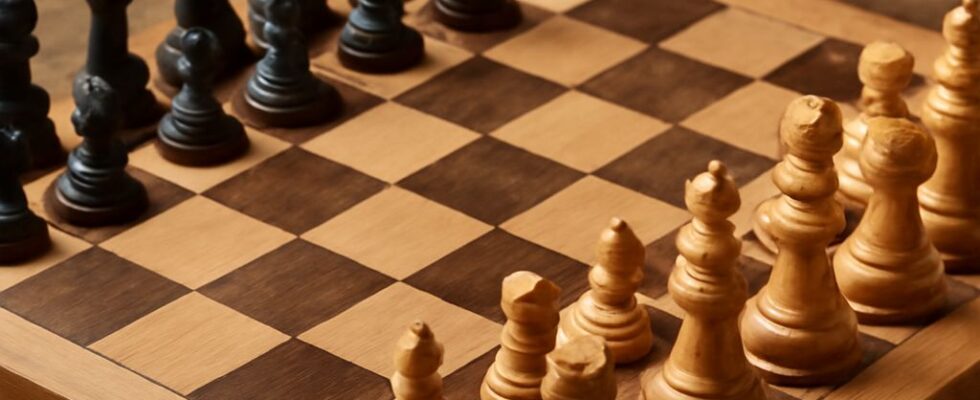
How do you start a game when the pieces aren’t in their usual places? In Fischer’s random chess, you arrange the back rank under a few constraints, mirror it for Black, and then play with normal chess moves. Castling has familiar destination squares, even when the king and rook start somewhere surprising.
Fischer Random Setup: Three Rules for the Back Rank
In Fischer Random, both players start with the usual eight pawns: White on rank 2 and Black on rank 7. Randomize White’s remaining pieces across rank 1, following these rules:
- Put the two bishops on opposite-colored squares.
- Put the king somewhere between the two rooks. They don’t have to be adjacent.
- Place Black’s pieces directly opposite White’s matching pieces on rank 8.
A computer generator can produce a legal position for Fischer’s randomized chess for you. There are 960 possible arrangements, including the standard chess setup. In Chess960, both sides get the same arrangement, so a white rook on c1 faces a black rook on c8.
For a concrete example, read White’s back rank from a1 through h1: bishop, knight, rook, king, rook, bishop, knight, queen. The bishops occupy opposite colors, and the king on d1 stands between the rooks on c1 and e1. Black mirrors that arrangement across the board. Pawns still fill the second and seventh ranks.
Play the Pieces as Usual
Once the Chess960 board is ready, White moves first in this randomized Fischer variant. Bishops move diagonally, rooks move along ranks and files, and knights jump in their usual L shape. The queen combines rook and bishop movement; the king moves one square in any direction. Pawns move and capture as in standard chess, including promotion and en passant when the usual conditions apply.
Check, checkmate, and stalemate work the same way too. The 960-position chess variant changes which pieces begin on which squares; it doesn’t give a bishop permission to hop over a pawn. Look at the actual position before making your first move: an unguarded pawn or a useful diagonal may appear in an unfamiliar place.
Castling: Think About the Destination
In Fischer’s randomized chess, castling is still one move involving your king and one rook. Your king and the chosen rook must not have moved earlier. You can’t castle while in check, through a square attacked by an enemy piece, or onto an attacked square. The king’s starting square, its route, and destination must be safe.
The squares between each piece’s starting square and its destination, including the destination, must be empty except for the castling king and rook. The rook can cross an attacked square. Depending on the position, one piece may already be on its destination, or the two may exchange squares.
In this 960-position chess game, the final squares for White are fixed:
- G-side castling: king on g1 and rook on f1, written 0-0.
- C-side castling: king on c1 and rook on d1, written 0-0-0.
For Black, use the same files on rank 8: g8 and f8, or c8 and d8. The FIDE rules describe the full procedure.
Take the example setup above. Suppose the pieces and pawns have moved as needed, neither participating piece has moved, and all safety and vacancy conditions are met. For g-side castling, White’s king goes from d1 to g1 and the rook from e1 to f1. Squares f1 and g1 must be clear, and the king’s route must be safe.
For c-side castling from that same original setup, the king on d1 and rook on c1 exchange squares: king to c1, rook to d1. Those two pieces occupy each other’s destinations, which is allowed. These examples show why Fischer’s random variant rewards checking squares rather than counting two king steps.
Your Pre-Game Checklist
Before your first game of 960-position chess, generate a legal back rank, check opposite-colored bishops and a king between rooks, then mirror the pieces for Black. Agree how you’ll signal castling on a physical board. During play, check that the king and chosen rook retain their rights, their required paths are clear, and every square the king occupies or crosses is safe. Finish with the king and rook on the appropriate c/d or g/f squares.